
Applying the Communication Mindfulness Approach: A 10-Step Checklist for Online Safety
Course | Introductory | Module | 5
Introduction: Applying the Communication Mindfulness Approach
Now that we have explored online communication through the lenses of technology, language and psychology, we can cement our understanding of a holistic approach to online safety. This requires that we combine our knowledge of the basic best practices and common misconceptions surrounding different types of online scams, as well as of language analysis and the psychology of online communication.
To do this, we can compile a ten-step checklist which summarises the key parts of the Communication Mindfulness approach to online safety. Below, a summary table of this ten-step checklist is provided, followed by a bullet-point list explaining its different steps. The accompanying infographic also provides a downloadable copy of the checklist for easy use.
However, it is still important to remember that we should treat our online safety as a skill we are constantly working to improve, rather than allow such a checklist to become a simple habit we follow without thought. We should also strive to maintain an active awareness of our digital surroundings in our role as mindful digital citizens, by seeking to increase our knowledge of our online surroundings on a regular basis.
A 10-Step Checklist for Online Safety:
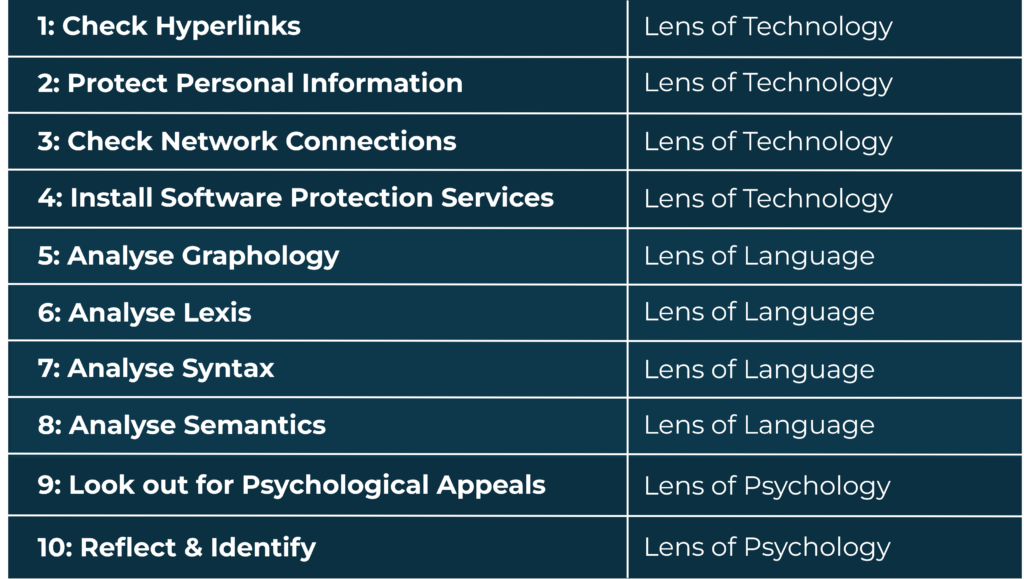
1: Check Hyperlinks:
- Secure Hyperlinks (i.e. those starting with HTTPS)
- Spoofed Hyperlinks (e.g. missing letters, numbers substituted for letters, additional punctuation, etc.)
- Inconsistencies (i.e. when the actual hyperlink does not match the hyperlink text)
2: Protect Personal Information:
- Keep personal information private (e.g. passwords, account details, credit card numbers, addresses, etc.)
- Ask the following questions before sharing any sensitive information:
- Is it really necessary for the recipient to know about this information?
- Could the shared information be used to gain access to personal accounts, or to target colleagues, friends, family or businesses?
3: Check Network Connections:
- Make sure to use private hotspots, instead of public Wi-Fi.
- If using public Wi-Fi is necessary, use a trusted VPN provider.
4: Install Software Protection Services:
- If one is not already installed, consider using a trusted software protection service like McAfee to help protect personal and device data.
For Potential Online Scams:
5: Analyse Graphology:
- Branding (e.g. logos, colour schemes, font styles, etc.)
- Colours
- Font and Text Styles (e.g. underline, bold, italics, capitalisation, etc.)
- Other Visual Elements (e.g. banners, buttons, images, hyperlinks, etc.)
6: Analyse Lexis:
- Misspellings
- Unusual Spellings
- Word Choices
7: Analyse Syntax:
- Punctuation (e.g. !, ?, ., etc.)
- Sentence Types (e.g. commands, exclamations, questions, statements, etc.)
8: Analyse Semantics:
- Word Choice
- Tone (e.g. informal, formal, humorous, etc.)
9: Look out for Appeals to:
- Trust (e.g. spoofed brands, unusual messages on trusted social media platforms, etc.)
- Authority (e.g. unusual correspondence from banks, other financial institutions, government departments, etc.)
- Risk vs Reward (e.g. financial opportunities, unrealistic rewards, etc.)
- Social Norms (e.g. staying up-to-date with trends, well-known brands, popular products, etc.)
- Emotions (e.g. distressing images, sympathetic backstories, attempts to build romantic relationships through emotive language, etc.)
10: Reflect & Identify:
- What actions am I being pressured or persuaded to take (e.g. clicking on a hyperlink, downloading an attachment, installing software, etc.)?
- Is it necessary for me to carry out these actions, or should I take a few moments to reflect and ask someone I trust for advice on what to do next?
Conclusion:
Over the course of this article, we have combined our knowledge of the lenses of technology, language and psychology to arrive at a holistic approach to online safety. To cement this Communication Mindfulness approach, we also created a ten-step checklist which we can use to help us maintain an active awareness of our digital surroundings and a mindful approach to our online safety.