

Language Clues: Language Analysis the Communication Mindfulness Way
Course | Introductory | Module | 3
“A special kind of beauty exists which is born in language, of language, and for language.”
~Gaston Bachelard, French Philosopher
Introduction: Language Analysis the Communication Mindfulness Way
In the previous article, we developed our very own ‘language theatre’ to help us understand what graphology, lexis, syntax and semantics are, and why these elements of language analysis are so important for our online safety. We also learned that language can be thought of as a tool for communicating, and that it can be used in various ways to achieve different goals. When it comes to online scams, this means that language can be used as a tool for influencing our thoughts and feelings, and for getting us to take certain actions, like giving away our personal information.
To combat this, we need to be able to identify language clues that can help us spot online scams and the ways in which they are trying to influence us. We can do this by learning to apply the four stages of analysis from our ‘language theatre’ to the online communication that we receive on a daily basis.
In this four-step approach to language analysis, we will start by evaluating the graphology of any unusual or unexpected messages that we receive. Then, we will analyse the lexis, syntax, and, finally, the semantics of each message. To make these steps easier to remember, we can return to the analogy that we developed in the previous article by imagining that we are watching a performance in a theatre:
- Firstly, we should focus on what we can see on stage, like the props and backdrops. This is the same as the graphology, or the visual elements, of the message we are reading.
- Secondly, we should focus on the characters we can see performing on stage. This is the same as the lexis, or the word choices, used in the message we are reading.
- Thirdly, we should focus on how the scenes we are watching have been put together to create an overall performance. This is the same as the syntax, or the sentence types and structure, of the message we are reading.
- Lastly, we should focus on how the performance has made us feel. This is the same as the semantics, or the overall tone and feel, of the message we are reading.
With this in mind, we will now discover some of the key language clues we can use to spot online scams. For each language element, a bullet-point list of questions is provided to help guide us through the steps of our analysis.
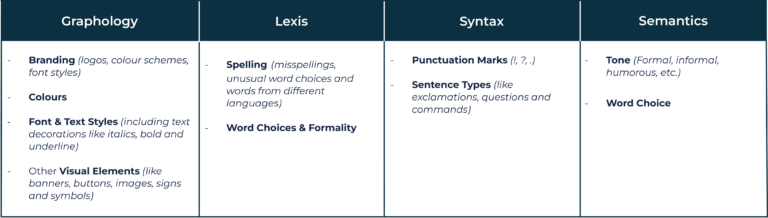
Step 1: Graphology Clues
- Branding
- Does the branding look familiar?
- If so, is the logo (the recognisable image used by a business as part of their branding) correct and of a high image quality? If the logo is very unclear, it could be because the image has been copied from the real business’ website or branding by online scammers.
- Are there any inconsistencies, like colours or font styles that do not match the business’ usual branding? These kinds of visual inconsistencies could point to a scam. In the case of a website, inconsistencies could also be present if the general layout or appearance of the website does not match what we remember it looking like.
- Colours
- What colours have been used in the message or on the website?
- If the message or website is related to a particular business, do the colours match their usual branding?
- Why have these colours been used? It may be helpful to consider how different colours make us feel or what they are traditionally associated with. For example, red is usually associated with danger or urgency, so it could be used by online scammers to make us feel pressured into acting quickly. On the other hand, green is a colour commonly associated with wealth, so it could be used by online scammers to make us feel curious about a financial opportunity.
- Fonts and Text Style
- What fonts have been used in the message or on the website?
- If the message or website is related to a particular business, do the fonts match their usual branding?
- Has any text been made bold, italicised, underlined or completely capitalised? If so, why? It may be helpful to consider where on the message or website the bold, italicised, underlined or capitalised text is found. Often, online scammers will use these kinds of text effects to draw our attention to the action they want us to take, like clicking on a button or a hyperlink. Fully capitalised text can also be used to create a sense of urgency, and to pressure us into taking a certain action.
- Other Visual Elements
- Have any other visual elements have been used? Examples of common visual elements include banners, buttons, images, signs and symbols.
- If so, why might these visual elements have been included? It may be helpful to consider what they draw our attention to and how they make us feel. For example, online scammers commonly use buttons to draw our attention to the action they would like us to take, like clicking on a hyperlink that will install malware or lead us to a fake website. On the other hand, elements like warning symbols may be used to create a sense of urgency, and to make us feel that we need to take immediate action.
Step 2: Lexis Clues
- Spelling
- Are there any incorrect spellings? If the misspellings are obvious and plentiful, this could point to an online scam. However, it is important to remember that with the use of AI, these kinds of obvious spelling errors have become much less common.
- Are there any unusual spellings or words from different languages? It may be helpful to consider where the sender of the online communication claims to be from, or in which country a business is based. This could influence whether they use British English, American English, or other spelling variations. For example, it would be very unusual for a company based in America to refer to itself as an ‘organisation’ (spelled with an s), because ‘organization’ (spelled with a z) is the preferred American spelling.
- Word Choices & Formality
- How formal or informal are the word choices that have been made? It may be helpful to consider whether the text we are reading seems more serious and business-like, or more friendly and casual. For example, more business-like word choices could include technical terminology, while more casual word choices could include contractions and slang.
- Are these word choices consistent with the sender of the online communication or the purpose of the website? Often, this will depend on the context of the online communication, as many businesses have come to use more informal lexis to reach a wider audience. However, it would be very unusual for a bank to send out formal notices or warnings that include slang, like ‘Howzit’ or ‘check it out’.
- Are there any unusual word choices that have been made? For example, a business reaching out to its clients is unlikely to use a greeting like ‘Hello friends’, while a message coming from a family member would be unlikely to include one like ‘Dear Sir / Madam’. Similarly, if we receive a message claiming to come from a someone we know that includes words or phrases they would never usually use, it could be a sign of a scam.
Step 3: Syntax Clues
- Punctuation & Sentence Types
- Are there any incomplete sentences, or ones that simply don’t make sense? If these types of sentences are obvious and plentiful, this could point to an online scam. However, it is important to remember that with the use of AI, these kinds of errors have become much less common.
- What type of punctuation has been used? It may be useful to consider whether there are any missing full stops, or whether other punctuation marks (like exclamation marks or question marks) have been used. For example, exclamation marks may be used by online scammers to create a sense of urgency.
- What types of sentences have been used? Are there mostly statements giving us information, or are there commands instructing us to do something? Once again, commands or exclamatory sentences may be used by scammers to create a sense of urgency and to pressure us to take action.
Step 4: Semantics Clues
- Tone & Word Choices
- What types of words are being used? Are they friendly, aggressive, persuasive or urgent? This is a good indication of the overall tone, or general attitude, of a message. For example, words like ‘friends’, ‘we’ and ‘could’ are more likely to sound friendly, while words like ‘you’, ‘they’ and ‘must’ are more likely to sound aggressive, depending on the context in which they are used.
- Does the tone of the online communication match its purpose? If there is an inconsistency here, it could be a key sign of an online scam. For example, a real business offering a promotion is more likely to sound persuasive than urgent, and an individual seeking our genuine assistance is more likely to sound friendly than aggressive.
Taking a Mindful Moment:
Even if we don’t ask ourselves all of these questions for every piece of online communication we receive or each website we visit, we should always be aware of how a message or website makes us feel. If we ever feel pressured to take action, or if something simply doesn’t sit right with us, it is always best to take a moment away from the screen. We can do something that takes our minds off of the message or website, like a quick walk around the room, before coming back to it. Then, we can take a look at the information we have in front of us again, double-check any hyperlinks that have been included, and ask ourselves whether there is really a need for us to take action.
Conclusion:
Over the course of this article, we have taken our understanding of language analysis one step further by learning what clues to look out for in the graphology, lexis, syntax and semantics of online scam messages. We have also started combining the lenses of technology and language to arrive at a more holistic approach to our online safety. In the next article, we will learn how to apply this combined analysis to an example of an online scams.